Inquiry
Form loading...
Choosing Carbon Steel Coil Hot Rolled is less about chasing the lowest price than matching the material to its job. A coil destined for a welded frame faces different demands from one destined for a formed bracket. Grade, thickness, width, surface condition, and tolerances all matter. So does the mill’s ability to provide traceable test documentation.
The scale is substantial. The World Steel Association reported global crude steel production of 1,882.6 million tonnes in 2024. That figure describes steel output, not hot-rolled coil availability or quality. Buyers should not treat it as a purchasing forecast. In its production guidance, ASTM International’s A1011/A1011M specification offers a useful reference for hot-rolled sheet and strip requirements. Check the applicable edition and confirm that its scope fits your product.
As World Steel Association Director General Edwin Basson has said, “Steel is the most important engineering and construction material in the world.” For buyers, that broad point becomes practical only through careful specification. Request the grade, dimensional tolerances, coil weight, edge condition, and inspection records in writing. Ask how the material will behave during cutting, forming, or welding. A certificate cannot replace a trial on your own equipment. That part is easy to overlook.
There is no universal best coil. A cheaper option may bring more scrap or rework; a premium grade may add cost without improving performance. Start with the finished part, then compare supplier evidence against your actual process. Revisit the choice after production data comes in. Real results may challenge the original assumptions.
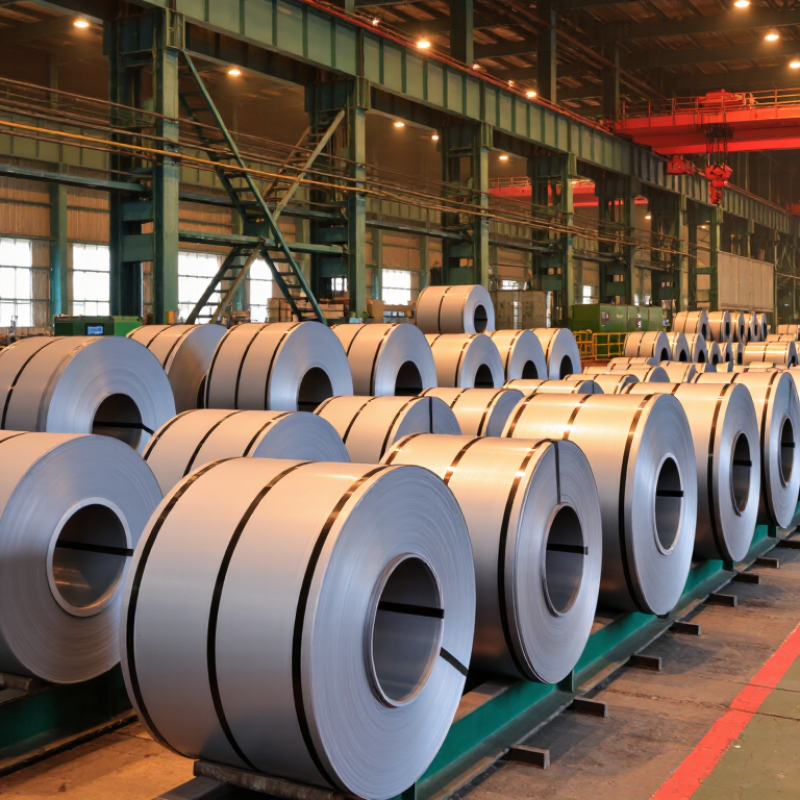
Start with the service, not the grade name. Record the coil’s end use, forming depth, bend radius, weld method, design load, thickness, and exposure to moisture or chemicals. A bracket carrying load needs a different balance of strength and formability than a panel with tight bends. ASTM A1011 covers hot-rolled sheet and strip, including structural and forming grades. EN 10025-2 specifies hot-rolled structural steels. Not interchangeable. Confirm the exact product standard, delivery condition, and thickness range with the supplier.
Use the grade tables as measurable checks. ASTM A1011 Grade 36 specifies a minimum yield strength of 36 ksi, about 250 MPa. EN 10025-2 S355 specifies 355 MPa minimum yield strength for thicknesses up to 16 mm. These figures do not make the grades equivalent; chemistry, toughness, and test requirements also matter. The World Steel Association’s World Steel in Figures 2025 reports 1,882.6 million tonnes of crude steel production in 2024, useful context for a large, varied supply market—not proof that any coil suits your job. Small detail. Check the mill test certificate against the purchase specification, and verify bend performance on the actual thickness. I would not rely on a familiar grade label alone; that shortcut can miss a costly mismatch.
| Application or requirement | Typical selection direction | ASTM A1011 option | EN 10025 option | Key checks before ordering |
|---|---|---|---|---|
| General-purpose parts with moderate forming needs | Start with a formability-oriented commercial-quality grade when the design does not require a specified structural yield strength. | Commercial Steel (CS), with the applicable type specified when required | Choose a grade appropriate to the product specification and forming requirements; S235JR is a structural grade, not a direct equivalent to ASTM CS. | Confirm forming severity, bend radius, thickness, surface condition, and any chemistry or mechanical-property requirements. |
| Light structural components and brackets | Use a structural grade with a specified minimum yield strength suited to the design loads. | Structural Steel (SS) Grade 36; minimum yield strength is 36 ksi (about 250 MPa) for applicable product ranges. | S235JR; minimum yield strength is 235 MPa for nominal thickness up to 16 mm. | Verify the applicable thickness range, delivery condition, impact requirements, and governing design code. |
| Frames, supports, and general fabrication with higher strength needs | Consider a higher-strength structural grade when it helps meet the design load without relying on an assumed grade equivalence. | Structural Steel (SS) Grade 50; minimum yield strength is 50 ksi (about 345 MPa) for applicable product ranges. | S355JR; minimum yield strength is 355 MPa for nominal thickness up to 16 mm. | Check thickness-dependent requirements, weldability, forming limits, and whether the required toughness suffix and test temperature are specified. |
| Load-bearing parts where strength is more important than extensive forming | Select the required strength from structural calculations, then confirm fabrication and inspection requirements. | Choose an A1011 SS grade whose specified properties meet the design; Grade 50 is one common higher-strength option. | S275JR may suit applications requiring more strength than S235JR; its minimum yield strength is 275 MPa for nominal thickness up to 16 mm. | Do not select solely by a grade number. Confirm actual thickness, design basis, joint details, and required material certification. |
| Parts requiring significant bending or forming | Prioritize the standard’s formability requirements and validate the proposed grade with the part geometry and process. | Consider Commercial Steel (CS) or another A1011 category specifically suited to the required forming; do not assume a structural grade will form equally well. | Confirm that the selected product specification and grade are suitable for the intended forming operation; structural strength designation alone does not define forming performance. | Assess bend radius, rolling direction, edge quality, thickness variation, and the need for production trials. |
| Standards and equivalence | ASTM A1011 and EN 10025 use different grade systems and requirements. The grade examples above are selection starting points, not guaranteed equivalents. Confirm the current standard edition, product form, thickness range, mechanical properties, chemistry, testing, and certification in the purchase specification. | |||
| Coil and delivery details | State that the required product is hot-rolled coil and confirm the applicable product standard covers the ordered form. Specify thickness, width, coil mass or dimensions, surface condition, edge condition, tolerances, and any pickled or oiled condition separately where required. | |||